

Zero Waste

Zero Waste
What is Zero Waste?
Zero Waste is an ideal to work towards, with its goal being to reduce or eliminate what we send to land fill and what pollutes our environment. From fast fashion to plastic fabrics (eg Polyester, Nylon) the fashion industry creates unimaginable amounts of waste. We need to stop this.
At ‘by Audrey & Grace’, we are working towards reducing our waste and impact on the environment through different avenues. Zero Waste is one of these.
Zero Waste can take on many different forms in the fashion/clothing industry. There is both pre-consumer and post-consumer to consider, the manufacturing process, materials and a circular life.
For me, zero waste is the starting point for circularity, not something separate from it. The Ellen MacArthur Foundation frames circular design around three principles: eliminate waste and pollution, keep products and materials in use, and regenerate natural systems. Zero waste is that first principle put into practice, right at the cutting table, before a single stitch is sewn. Seamless Australia, whose stewardship scheme I'm part of, defines circular design in a similar way, clothing that's more durable, repairable, sustainable and recyclable, part of a system that designs out waste rather than managing it after the fact.
My own approach to it didn't start with a grand plan. It started with an aversion to throwing things out, especially fabric. I found myself looking at the whole process, right down to the threads used in overlocking and trimmed away afterward, and thinking there had to be a better way.
The Zero Waste Top is a good example of this, cut from one length of fabric with nothing left over.
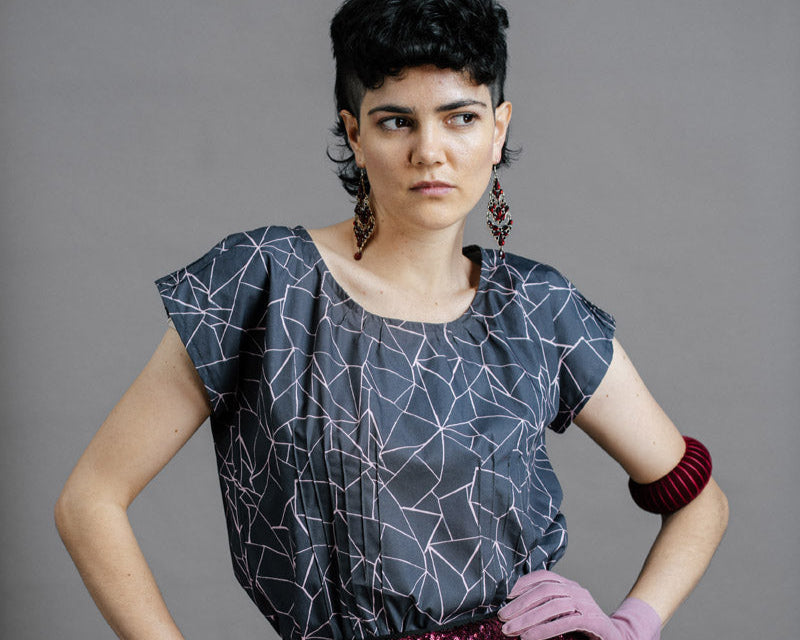
This isn't actually a new idea either. Traditional garments across many cultures were built this way long before anyone called it "zero waste." The kimono is made from eight rectangular panels, cut without a single curve. The sari is shaped entirely through draping. The chiton, himation and peplos of ancient Greece were simple rectangles of cloth, wrapped and pinned into place. These garments still followed the fashions and customs of their time, that hasn't changed. What has changed is the respect. Fabric was precious, made and worked by hand, and expensive, so it simply couldn't be thrown away. That respect, more than the specific shapes, is what's been lost.
The kimono carries this even further than most people realise. Because it's built from straight panels rather than curved seams, a kimono could be taken apart entirely and rebuilt, the fabric washed and reused, sometimes as a new kimono, sometimes as something else altogether. Even the tiniest leftover pieces had a purpose. During the Edo period, women turned scraps too small for garments into small handcrafted keepsakes, nothing was too small to matter. Some kimono fabric was even woven through with genuine gold and silver, metal beaten thin and sliced into fine strands before weaving, a fabric far too valuable and labour intensive to ever waste. And it's not only historical record, kimono made well over a hundred years ago are still around today, held in museums and private collections, proof of how far genuine quality and care can carry a garment.
Zero waste has become one of the most important parts of my design philosophy, and increasingly guides the direction I take with new pieces. It isn't the only lens I design through, some pieces call for a different approach, but it's the one I keep returning to.

The flower detail here is made entirely from the offcut of the neck hole, nothing wasted, nothing added.
How I Actually Cut For Zero Waste
In practice, this means working entirely within the width of the fabric I have, rather than laying a pattern out and cutting away whatever doesn't fit. Every piece I need has to come from that same length, so the pattern becomes more like a puzzle than a traditional layout. It takes a lot more planning up front, and often several attempts before a layout actually works.
Sometimes that fabric is new. Just as often, it's repurposed, preloved doona covers, or genuine deadstock that would otherwise be heading to landfill. I love finding gorgeous fabric in op shops and giving it a second life, fabric once made by hand from precious, renewable materials, finally getting the use it deserves rather than gathering dust in a cupboard. If anything's left over once a garment's cut, it becomes something else entirely, a handkerchief, a pouch, in the same spirit as those old kimono scraps finding new purpose. Even my selvedges, the unprinted edges with the fibre ends, get saved and used as stay tape wherever a bit of tape is needed.
My Zero Waste Tops and Zero Waste Skirts are where this shows up most clearly. On the Zero Waste Top, the neck hole itself becomes the flower. The side pieces I cut away become the binding and the centre of that same flower. Nothing leaves the cutting table without a job to do.
Thinking About End of Life
Design doesn't stop at construction either. It has to consider the end too. What happens to a garment once its life with you is over? Can it break down naturally? Or is it synthetic and poorly made, destined for landfill or incineration, releasing pollution into the air on the way? Is it a blend that makes recycling nearly impossible?
My training through Seamless Australia's stewardship scheme has shaped a lot of my thinking here, real compostability is a much higher bar than most people realise, it usually requires specific industrial composting conditions, not just a home compost bin, and very few textiles genuinely meet it yet. When a garment is made from 100% natural, single fibres, cotton or linen for example, it at least opens up a genuine circular pathway, mechanical recycling now, and hopefully true compostability as the standards and options improve. I'm working towards that across the range. This is still very much a work in progress, watch this space.
Before any of that though, I'd always encourage extending a garment's life first. Hand it on to someone who'll love it, sell it through a secondhand platform, or donate it if it's still in good condition. Recycling is the last step, not the first.
Is there a truly 100% zero waste garment? Realistically, that would have to be the piece you already own. But there's a goal here, and a way of thinking that comes with it, and it changes things far more than people expect.
Quality and Longevity
Zero waste thinking doesn't stop at cutting, it shapes construction too. I use French seams on many pieces, a rather old fashioned finish, and one with genuinely two schools of thought on its place in modern clothing construction. I fall firmly on one side of that: I believe it gives a cleaner, more luxurious finish, but more importantly, it makes for a stronger, longer lasting seam. It's exactly this kind of detail, thought about and considered rather than skipped for speed, that separates a garment built to last from one that isn't.
That's really what quality comes down to for me. A well made garment should last years, decades even, worn by one person, then finding a new home, maybe more than once. The most sustainable garment is often simply the one that stays in use the longest.


The Floriferous skirt is another good example, made entirely from a rescued doona cover found in an op shop, its soft grey botanical print given a completely new life rather than being thrown away.
I also print fabric to order rather than holding large inventories, which cuts overproduction waste for both me and my printer. And I won't pretend any of this is the easy way. It takes longer, and it can limit design creativity. But when a pattern genuinely can't be cut without some waste, I still spend real time finding the layout that leaves as little behind as possible, because waste simply doesn't sit right with me.
